

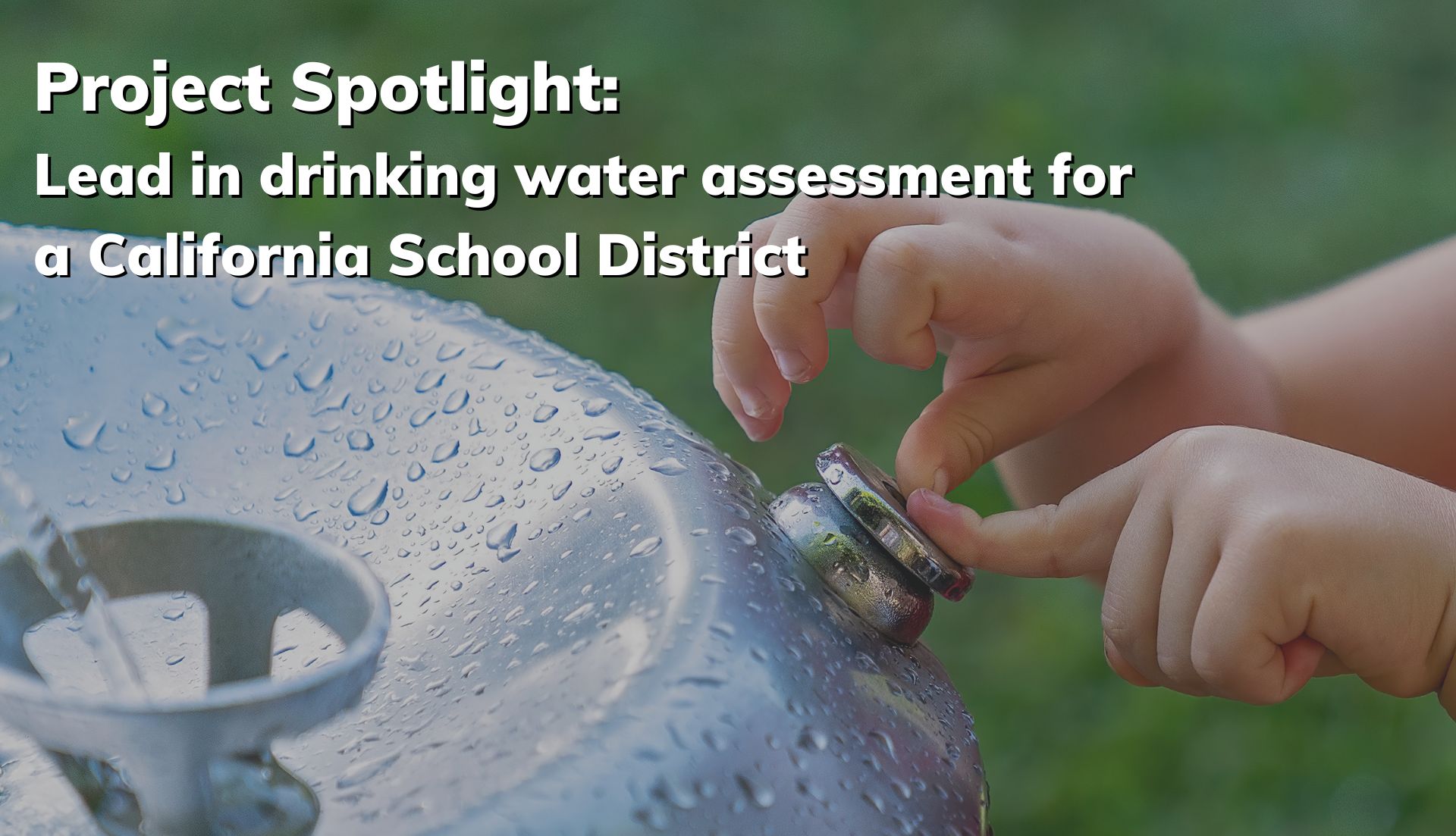
Lead in Drinking Water Testing for California Child Care Centers: A Three-Site Project Breakdown
California’s AB 2370 requires licensed child care centers to test their drinking water for lead every five years. If your facility completed its first round of testing in 2022 or 2023, that next cycle is closer than it feels.
A Southern California school district recently hired A-Tech Consulting to handle lead in drinking water testing across three licensed child care facilities in a single project. Twenty-five fixtures, three campuses, two days of fieldwork. Here’s how it came together and what child care providers, Head Start programs, and district facilities managers should understand before scheduling their own testing.
What AB 2370 Actually Requires
Assembly Bill 2370 applies to all licensed childcare centers in California located in buildings constructed before January 1, 2010. It requires testing at every point of use (POU) where children or staff access water for drinking or food preparation — sinks, drinking fountains, water dispensers, kitchen faucets, and outdoor playground fixtures.
The California Department of Social Services (CDSS) sets the action level at 5 ppb (parts per billion). Any result at or above 5.5 ppb is classified as an Action Level Exceedance, which requires the affected fixture to be immediately taken out of service and remediated before it can be used again. Results below 5 ppb mean no further action until the next 5-year testing cycle.
Sampling must be conducted by a certified external water sampler — someone credentialed by the California Department of Public Health (CDPH) — using EPA-approved protocols. Results have to be submitted electronically to the California State Water Resources Control Board. There’s real infrastructure behind a compliant test, and cutting corners on any piece of it creates problems even when the lead numbers come back clean.
How A-Tech Handled a Three-Site Assessment
The project covered three child care facilities with a combined total of 25 POUs across classroom sinks, restroom faucets, kitchen fixtures, and outdoor playground drinking stations. Each site had a different layout and fixture count, so sample locations were mapped in advance for all three campuses before any fieldwork began.
Step 1: Pre-Sampling Preparation
The evening before sampling, A-Tech’s CDPH-certified Lead Sampling Technician visited each facility to seal every designated POU with resealable bags and tape. No fixture could be used until sampling was completed the following morning. This 8 to 18-hour stagnation period is required under the EPA’s 3Ts Guidelines. The idea is straightforward: you want to test water that’s been sitting in the pipes overnight, because that’s the realistic worst-case exposure scenario for a child getting a drink first thing in the morning.
This visit also can’t happen during school breaks, holidays, or extended shutdowns. AB 2370 explicitly requires sampling to take place during normal operating periods. For active campuses, coordinating after-hours access across multiple sites takes planning.
Step 2: First and Second Draw Sampling
The following morning, the technician collected first-draw cold water samples from all 25 POUs before any fixtures were used. A second-draw sample was also collected from the first outlet at each site, per EPA 3Ts Guidelines, to capture lead concentrations deeper in the plumbing. All samples went into labeled 250-mL wide-mouth bottles and were documented on chain-of-custody (COC) forms recording the facility ID, sample time, location, water source, and potability classification.
Step 3: Laboratory Analysis
Use of a California Environmental Laboratory Accreditation Program (CA ELAP)-certified lab is a requirement under AB 2370. Results from uncertified labs do not satisfy the regulation. Samples were delivered under COC protocols to a CA ELAP-certified laboratory for analysis using EPA Method 200.8. Results were reported in micrograms of lead per liter of water (µg/L), which is equivalent to parts per billion.
Step 4: Reporting and Regulatory Submission
A-Tech prepared a full Limited Lead in Drinking Water Assessment (LDWA) report for each facility. Each report included sample location maps, photographs of every POU, complete lab reports, chain-of-custody documentation, CDPH inspector certifications, and the lab’s CA ELAP accreditation records. Results were submitted electronically to the California State Water Resources Control Board, as required.
The Results
Every sample across all three sites came back below the CDSS action level of 5 ppb. The majority of fixtures returned non-detect results. A small number showed trace lead concentrations, with the highest detection at 1.96 µg/L, well below the threshold.
No remediation was required. The district received a complete compliance record for all three facilities and documentation ready for submission to the State Water Board.
What Child Care Providers Should Know Before Their Next Test
- The 5-year cycle is already running. If your facility completed initial AB 2370 testing in 2022 or 2023, you’re approaching the window for your second round. Getting on a testing provider’s schedule early matters, especially during busy periods when access coordination takes longer.
- Certified external water sampler credentials are non-negotiable. AB 2370 requires sampling to be conducted by a CDPH-certified professional. Before hiring any environmental firm for this work, confirm that the technician performing the sampling holds a valid CDPH Lead Sampling Technician or Lead Inspector/Assessor certification.
- Stagnation requirements affect your schedule more than you’d expect. The technician needs after-hours access the night before sampling to seal every fixture. No water can be used in the building during the stagnation window. For a multi-site project, coordinating that across several campuses requires real lead time, and the testing can’t be scheduled during breaks or shutdowns.
- Documentation is as important as the test results. A passing result with incomplete paperwork still creates compliance problems. The full report needs to include inspector certifications, CA ELAP lab accreditation, chain-of-custody forms, site maps, and POU photographs. All of it has to be submitted to the State Water Board electronically.
- Low results are not a reason to stop paying attention. There is no safe level of lead exposure for children. Even facilities with all non-detect results should track aging plumbing infrastructure and stay ahead of their re-testing schedule rather than waiting for the deadline.
Ready to Schedule Your Child Care Center Lead Testing?
If your facility is approaching its five-year testing deadline, or if you’re not sure where you stand in the AB 2370 cycle, A-Tech Consulting can help you figure it out. Our CDPH-certified team manages the entire process — pre-sampling preparation, sampling, lab coordination, LDWA reporting, and State Water Board submission.
Contact A-Tech Consulting at (800) 434-1025 or request a consultation today.