

Know Your Exposures.
Verify Your Controls
Workplace exposures are not always obvious. Dust, chemical vapors, metals, gases, and noise can vary depending on the task, equipment, ventilation, and how work is performed.
A-Tech Consulting, Inc. provides occupational exposure assessments to help employers understand actual employee exposure, compare measured conditions with applicable occupational exposure limits, and determine whether existing controls are adequately managing exposure.
Our Industrial Hygiene team supports facilities throughout California, Washington, and other states with personal exposure monitoring, air sampling, noise assessments, ventilation evaluations, and OSHA compliance support.
When Should You Consider an Exposure Assessment?
An exposure assessment may be appropriate when:
Not sure what to test? Our Certified Industrial Hygienists (CIHs) review your processes, SDS, employee concerns, and controls to build the right sampling strategy.
- Employees report dust, odors, fumes, chemicals, or noise.
- Dust, fumes, or airborne contaminants are visible.
- A new chemica, material, process, or equipment is introduced.
- Ventilation or local exhaust performance is uncertain.
- PPE or engineering controls need evaluation
- OSHA, an insurer, or your safety program requires monitoring
- You need to establish baseline exposures
- Previous Monitoring requires follow up
Our Exposure Assessment Services
Airborne Contaminant Monitoring
Personal exposure monitoring helps determine what an employee is exposed to while performing their normal work activities. What we sample for depends on your process.
Services include:
- Respirable dust
- Respirable crystalline silica
- Metals, including welding fume
- Volatile organic compounds (VOCs)
- Solvents and other chemical vapors
- Gases and other process-specific contaminants
Noise Monitoring
Workplace noise can vary significantly depending on equipment, production activities, and how long employees spend in different areas.
Services include:
- Personal noise dosimetry
- Area sound level measurements
- Identification of high-noise tasks or areas
- Hearing conservation program support
Results can help determine whether additional engineering controls, administrative controls, hearing protection, or hearing conservation measures should be considered.
Waste Anesthetic Gas Monitoring
Healthcare, dental, and veterinary environments may involve occupational exposure to nitrous oxide and other anesthetic gases.
Services include:
- Nitrous oxide monitoring
- Halogenated anesthetic agent sampling
- Evaluation of procedure or operating room conditions
Ventilation and Fume Hood Testing
Ventilation is an important part of controlling airborne contaminants before they reach an employee’s breathing zone.
Services include:
- Local exhaust ventilation inventories
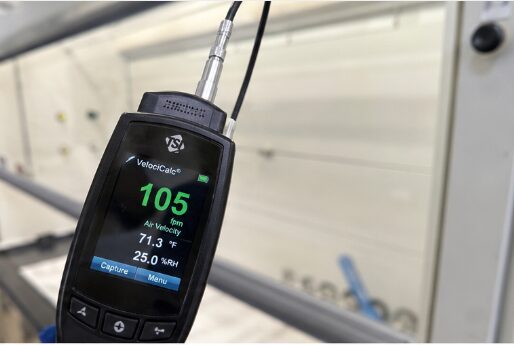
- Airflow and velocity measurements
- Smoke visualization
- General ventilation assessments
- Laboratory fume hood face velocity testing
How an Exposure Assessment Works
- Understand the Process. An industrial hygienist reviews the work activities, chemicals, materials, equipment, employee concerns, and existing controls to identify potential exposure pathways and determine what should be evaluated.
- Measure Actual Conditions. Personal, area, noise, or ventilation measurements are collected while employees perform representative work activities. Where appropriate, personal exposure samples may be collected over a full work shift or during specific tasks to characterize employee exposure.
- Compare Results to Exposure Limits. Samples are analyzed by accredited laboratories and compared with applicable occupational exposure limits. Most limits are an 8-hour time-weighted average (TWA). Some substances also have a lower action level that triggers monitoring, training, or medical surveillance.
- Provide Clear Recommendations. You receive a written report, with practical recommendations, that your management, EHS, or operations team can use to make informed decisions. See What You Receive below.

Exposure Limit Examples
Federal OSHA limits for common hazards:
| Hazard | Exposure limit8-hour TWA unless noted | Action level | Standard |
|---|---|---|---|
| Respirable crystalline silica | 50 µg/m³ | 25 µg/m³ | 29 CFR 1910.1053 |
| Lead | 50 µg/m³ | 30 µg/m³ | 29 CFR 1910.1025 |
| Occupational noise | 90 dBA | 85 dBAHearing conservation program | 29 CFR 1910.95 |
| Waste anesthetic gases | No OSHA PELNIOSH REL: 2 ppm halogenated agents (60-minute ceiling); 25 ppm nitrous oxide (TWA during administration) | None; keep as low as reasonably achievable | NIOSH REL |
State programs can be stricter. In California, for example, the Cal/OSHA lead standard (Title 8, Section 5198) has set a PEL of 10 µg/m³ and an action level of 2 µg/m³ since January 1, 2025. Depending on the contaminant and jurisdiction, results may also be evaluated against Cal/OSHA or Washington DOSH limits, NIOSH recommended exposure limits, or ACGIH threshold limit values.
What You Receive
Each report explains what the laboratory data means for your workplace and what to do next.
Reports typically include:
- Sampling and monitoring results
- Comparison with applicable occupational exposure limits
- Identification of potential exposure concerns
- Evaluation of existing engineering or administrative controls
- Recommendations for additional controls or follow-up monitoring
- Documentation to support your occupational health and safety program
Reports are delivered through EnviroShare®, A-Tech’s client portal, so your records stay organized and easy to pull for audits or follow-up monitoring.
Industries We Serve
Lorem ipsum dolor sit amet, consectetur adipiscing elit. Ut elit tellus, luctus
A-Tech supports occupational exposure assessments for a variety of workplaces, including:
- Manufacturing and industrial facilities
- Healthcare facilities
- Laboratories and research facilities
- Construction operations
- Municipal facilities
- Commercial properties
- Warehouses and distribution facilities
- Education facilities
Schedule an Occupational Exposure Assessment
Frequently Asked Questions
It is a measurement of the airborne contaminants, gases, and noise your employees are exposed to during their work, compared against applicable occupational exposure limits. The goal is to confirm whether exposures are within those limits and whether your ventilation and other controls are effective.
The employee wears a small sampling pump with collection media positioned in the breathing zone. Samples are collected over a full shift or during specific tasks, analyzed by an accredited laboratory, and typically reported as an 8-hour time-weighted average, the basis for most OSHA limits.
Substance-specific OSHA standards, such as those for silica, lead, and asbestos, require an exposure assessment when employees may be exposed at or above the action level. The noise standard requires monitoring when exposure may reach an 8-hour average of 85 dBA. Employee complaints, a new process, or a compliance audit are also common triggers.
The permissible exposure limit (PEL) is the maximum average exposure allowed over a set period. The action level is a lower threshold (for silica, half the PEL) that triggers requirements such as periodic monitoring, training, or medical surveillance before exposure reaches the PEL.
A-Tech serves industrial, healthcare, laboratory, construction, and municipal clients across California, Washington, and other states. Monitoring is performed on site at your facility.
Frequency depends on the contaminant and the results. Many OSHA standards require periodic monitoring when results are at or above the action level, more often when they exceed the PEL. We recommend a schedule based on your results and any changes to your processes.