
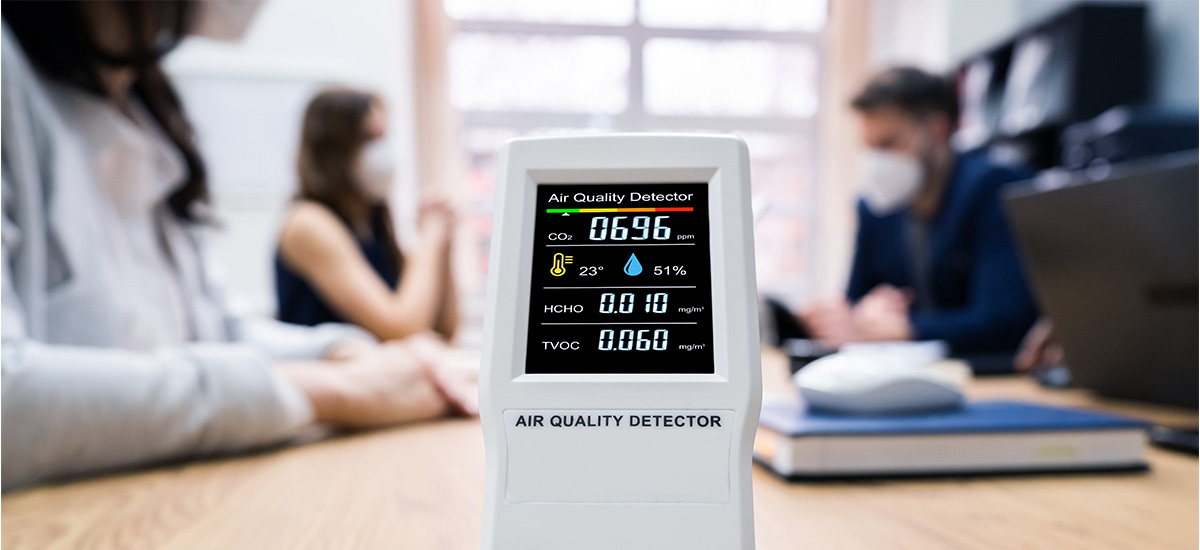
If your employees are complaining about headaches, your post-renovation space smells off, or you’re facing an inspection, you need answers fast. Indoor air quality (IAQ) is a high-stakes business issue that directly impacts employee health, legal compliance and your liability exposure. The Environmental Protection Agency (EPA) reports that, without sufficient ventilation, concentrations of some pollutants can be higher indoors than outdoors.
This guide gives you a clear action plan. You’ll understand what’s at stake, when testing is necessary, what contaminants pose risks and how the process works to protect your occupants and operations.
Why Indoor Air Quality in the Workplace Matters
Commercial indoor air quality testing has evolved from a comfort issue to a critical liability metric. When air quality problems go unaddressed, you face financial consequences, legal exposure and operational disruptions.
The Impact on Employee Health and Productivity
When employees complain about headaches, fatigue or difficulty concentrating, you’re facing a problem you can’t see but can’t ignore. Poor IAQ has been tied to symptoms such as nose, lung, throat, and eye irritation, headaches, fatigue, and trouble concentrating.
Poor IAQ also reduces cognitive function, decreasing focus and slowing response times. Even small declines in mental performance translate to productivity losses that affect your bottom line.
The Financial and Legal Risks of Ignoring IAQ
This is what’s at risk when persistent IAQ issues go unaddressed. The OSH Act’s General Duty Clause requires employers to provide workers with a workplace free from recognized hazards that are likely to cause death or serious injury. Failing to investigate known complaints can expose your organization to enforcement actions and liability claims.
Equipment performance also suffers when contaminants accumulate in HVAC systems, leading to premature failures and higher maintenance costs. When systems work harder to compensate for poor ventilation, energy costs rise accordingly.
The Link Between IAQ, Building Performance and Operational Efficiency
Many IAQ complaints are associated with improperly operated HVAC systems. Addressing IAQ problems often reveals underlying building performance issues that, when corrected, improve both air quality and energy efficiency.
Inside air quality testing provides the baseline data necessary to identify inefficiencies and track improvement after system upgrades. This approach protects you from guesswork and gives you defensible data.
Common Triggers: When Should You Consider IAQ Testing?
Understanding when to seek air quality testing in commercial buildings helps you stay ahead of problems. Experiencing any of these situations means professional air quality testing can provide diagnostic clarity.
Investigating Employee or Tenant Health Complaints
Persistent unexplained symptoms or conditions that worsen indoors require objective data to identify the cause. When multiple occupants report similar issues, testing provides the answers you need to develop solutions and protect yourself from liability.
Post-Construction or Renovation Verification
Recently renovated spaces with that “new” smell indicate off-gassing — chemical compounds released as materials emit trapped particles at room temperature. Adhesives, carpeting, upholstery and manufactured wood products may emit harmful levels of volatile organic compounds (VOCs).
Testing serves as a quality check before occupants return. This verification confirms that ventilation systems are functioning properly and contaminant levels have dropped to acceptable ranges.
Proactive Compliance and Building Certifications (LEED, WELL)
Pursuing green building certifications makes air quality testing a strategic priority. The LEED Indoor Environmental Quality (IEQ) credit category rewards strategies like Enhanced Indoor Air Quality Strategies and Low-Emitting Materials, bringing financial, health and marketability benefits.
Air quality testing becomes your proactive measure that supports certification goals while establishing baseline performance data.
Investigating “Sick Building Syndrome”
When occupants experience acute health effects linked to time in your building but no specific cause can be identified, you’re dealing with sick building syndrome (SBS). This differs from building related illness (BRI), in which a specific contaminant causes a diagnosable illness.
SBS investigations require systematic testing to rule out common pollutants and identify contributing factors like inadequate ventilation, temperature extremes or humidity problems.
Understanding the Targets: Key Pollutants in a Commercial Environment
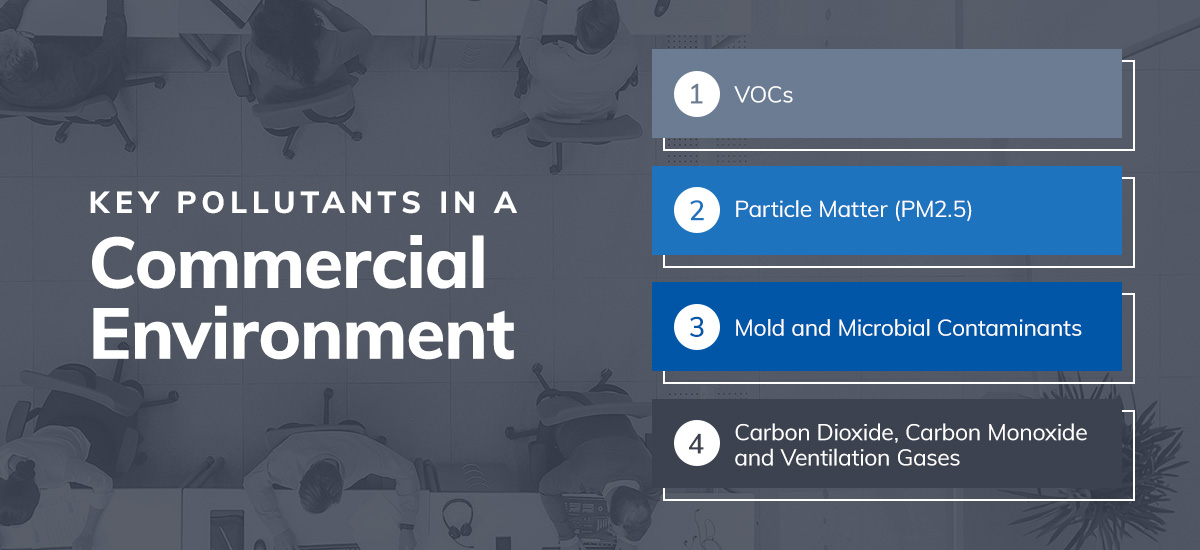
Professional indoor air quality testing focuses on specific contaminants based on your building type, occupancy and complaint patterns. Understanding what these pollutants are helps you recognize potential issues and interpret results:
- VOCs: Volatile organic compounds are carbon-based chemicals that easily evaporate into the air at room temperature. Common sources include copy machines, pesticides, cleaning agents and upholstery. VOC levels often spike after renovations or when new furniture arrives. When exposure continues over time, occupants may experience respiratory irritation and headaches.
- Particle matter (PM2.5): These microscopic particles bypass the body’s natural defenses, lodging deep in the respiratory system and creating serious health risks. Fine inhalable particles, known as PM2.5, measure 2.5 micrometers or smaller. Typical pollutants include combustion byproducts such as carbon monoxide and particulate matter from construction dust, unfiltered outdoor air and combustion sources. Construction activities or combustion equipment make particulate testing critical.
- Mold and microbial contaminants: Leaks, condensation issues or high humidity create conditions where biological contaminants like bacteria and mold can breed in stagnant water in ducts, drain pans or on water-damaged ceiling tiles and carpet. Addressing mold requires both removing existing growth and correcting the underlying moisture issue. Certified mold testing identifies the extent and verifies successful elimination after remediation.
- Carbon dioxide (CO2), carbon monoxide (CO) and ventilation gases: CO2 and CO serve different diagnostic purposes. High CO2 levels indicate poor ventilation and the accumulation of stale air. Carbon monoxide, by contrast, is a toxic gas produced by combustion sources that requires immediate attention. Measuring both gives you a complete picture of ventilation performance and safety risks.
A Step-by-Step Framework for Commercial IAQ Testing
When you engage professional testing, expect a structured process that delivers actionable answers and enables confident decisions about your next steps.
Step 1: The Initial Assessment and Walk-Through
Your investigation starts with a walk-through where professionals gather information on your occupants, HVAC system, pollutant pathways and contaminant sources. They’ll interview your team, review maintenance records and identify complaint areas.
This process establishes the context needed to develop targeted hypotheses. Visual inspection of HVAC systems and water-damaged areas provides clues that guide the sampling strategy.
Step 2: Developing a Strategic Sampling Plan
Air sampling alone seldom provides information about causes. Your sampling strategy will be based on a comprehensive understanding of your building and complaints, targeting the most likely contaminants rather than testing for everything.
Professionals select representative areas, including locations with complaints, typical office spaces and outdoor control points.
Step 3: On-Site Sampling and Data Collection
During sampling, professionals collect air samples in neutral airflow areas, typically in the center of rooms, avoiding direct airflow from HVAC systems, doors or windows. They will also gather outdoor comparison samples away from building influences.
The combination of field measurements and lab analysis provides both immediate screening data and detailed contaminant identification.
Step 4: Accredited Laboratory Analysis
Third-party accredited laboratories provide the unbiased, defensible results needed to make confident business decisions. Laboratory analysis identifies specific contaminants and quantifies concentrations, allowing comparison against regulatory standards.
This documentation supports your remediation planning, regulatory compliance and provides liability protection when necessary.
Take Control of Your Environment With A-Tech
Indoor air quality testing gives you control over your building’s environment and clarity to make data-driven decisions that safeguard your people and business performance. A-Tech provides comprehensive indoor air quality assessment services tailored to commercial facilities across construction, healthcare, manufacturing, education and property management sectors.
Our team combines advanced sampling techniques with accredited laboratory analysis to deliver the defensible, actionable results you need. From initial walk-throughs to strategic sampling plans and detailed reporting, we guide you through every step. Whether you’re responding to employee health complaints, verifying building performance or pursuing LEED or WELL certifications, A-Tech delivers the expertise you need.
Call 888-534-7930 to discuss your indoor air quality concerns today.